Author: command

Static vs Dynamic Load Management: QuickCharge Does Both, Better

Static Load Management (SLM): Simple, Controlled Sharing

In many locations, a predictable, pre-set configuration is enough. Static load management:

  • Shares a fixed amount of power evenly across all chargers
  • Prevents the total load from ever exceeding a set limit
  • Works well for small sites or locations with known, consistent demand

Example: You have a 40A circuit and four Level 2 chargers. Instead of upgrading your electrical service, QuickCharge can cap and share that 40A across all four chargers. No breaker trips, no surprises—just controlled, reliable charging.

Dynamic Load Management (DLM): Real-Time Optimization

For busier or more complex sites, QuickCharge offers dynamic load management, which:

  • Monitors the entire site’s power usage (not just the chargers)
  • Considers other building loads—lighting, HVAC, equipment, etc.
  • Adjusts each charger’s power level in real time
  • Responds automatically to changing conditions and demand

If your building’s load spikes, QuickCharge will temporarily reduce charging power to stay within your limit—then ramp it back up as capacity frees up. You get maximum utilization of your system without risking overload.

More Chargers, Less Infrastructure: The Core Benefit

With QuickCharge, you can typically:

  • Install more charging points on the same electrical capacity
  • Avoid or defer expensive panel and service upgrades
  • Add chargers gradually as EV adoption grows, without redesigning your power system

For property owners, businesses, and developers, this means:

  • Lower upfront costs
  • Faster deployment
  • Future-proofed infrastructure that can grow with demand

Smart Power Allocation: Not Just “Sharing,” But Optimizing

QuickCharge supports multiple allocation strategies to match your needs:

  • Balanced distribution – Share power evenly across all vehicles plugged in
  • Priority-based charging – Give faster charging to:
    • Fleet vehicles that must be ready by a certain time
    • VIP users, employees, or paid subscribers
    • Vehicles with the lowest state of charge
  • First-come, first-served – Maximize speed for early arrivals, then share as more cars connect

You decide the rules. QuickCharge enforces them automatically and transparently.

Lower Bills, Happier Grid: Beyond Just “Keeping the Lights On”

QuickCharge doesn’t just protect your electrical system—it also improves your operating costs and grid impact:

  • Demand charge reduction (peak shaving)
    • Avoid short-term spikes that lead to high demand charges
    • Smooth out charging loads over time
  • Time-of-use optimization (where supported)
    • Align charging sessions with lower electricity prices
    • Encourage off-peak charging through smart scheduling and controls
  • Grid-friendly behavior
    • Reduce strain on local transformers and distribution networks
    • Prepare your site for future integration with solar, storage, and V2G (vehicle-to-grid) solutions

Who Is QuickCharge Right For?

QuickCharge by Integra Energy is ideal for:

  • Commercial properties & workplaces – Office buildings, business parks, mixed-use developments
  • Multi-unit residential buildings – Condos, apartments, townhome complexes
  • Fleets – Delivery vans, service vehicles, corporate fleets
  • Public parking & hospitality – Hotels, shopping centers, parking garages, municipal lots

If you need multiple chargers on limited electrical capacity—QuickCharge is specifically designed for you.

The Consumer Experience: Reliable, Predictable Charging

Behind the scenes, QuickCharge is doing complex load optimization. For drivers, the experience is simple:

  • Plug in
  • See clearly how charging is progressing
  • Get the charge they need without worrying about the building’s power limits

No tripped breakers. No dead chargers. No “sorry, the system can’t handle it today.”

Ready to Build a Future-Proof EV Charging Site?

QuickCharge by Integra Energy delivers:

  • Cutting-edge dynamic and static load management
  • More chargers without major electrical upgrades
  • Lower operating costs and better energy efficiency
  • A smooth, reliable charging experience for every driver

If you’re planning an EV charging installation or expanding an existing one, QuickCharge gives you the intelligent foundation you need to grow confidently.

Want to learn how many chargers your site can support with QuickCharge? Contact Integra Energy for a site assessment and a customized load management plan.

Why Restaurants with EV Charging Stations Are Positioned to Win and How a Turnkey Solution Makes It Easy

As electric vehicles (EVs) become mainstream, owning a restaurant that doesn’t offer charging is a missed opportunity. EV drivers are always on the lookout for places to charge and they often choose a destination based on whether there’s a station available.

For restaurants, this change represents more than just another amenity it’s a chance to attract new customers, increase dwell time, and generate new revenue streams.

But simply installing a charger isn’t enough. To truly capture the benefits, restaurants need a solution that’s easy to deploy, backed by strong software, and supported end-to-end like the turnkey offering from Integra Energy.

1. EV Drivers Are a Growing Customer Base

There’s no question that EV adoption is accelerating. More drivers are going electric each year, and they plan around charging availability.

For restaurants, especially those located along highways, near shopping districts, and in town centers, offering EV charging means:

  • Attracting customers who might not otherwise stop
  • Encouraging longer visits perfect for dining in, shopping, or evening entertainment
  • Positioning your business as modern and future-ready

Studies show EV drivers often choose destinations where they can charge while they eat or shop, turning what used to be downtime into an incremental business opportunity.

2. Charging Brings Customers and Keeps Them There

Traditional restaurant marketing focuses on promotions and menus but EV charging is a location-based incentive. When a customer’s car needs power, they are locked in for the duration of that charge.

This increase in “dwell time” often translates to:

  • Larger ticket sizes (coffee + meal + dessert)
  • More repeat visits
  • Higher overall customer satisfaction

Customers get the convenience of charging, and restaurants get more seated guests a true win-win.

3. Charging Stations Can Generate Revenue

EV charging doesn’t have to be a free amenity. Restaurants can:

  • Charge per session or kilowatt-hour
  • Implement members-only pricing
  • Partner with mobile charging apps
  • Offer charging as a loyalty perk

With the right software, restaurants can track usage, set pricing rules, and monitor performance in real time. That’s where a comprehensive solution matters.

4. Why a Turnkey Solution Matters

Installing EV chargers sounds great but without the right support and software, the experience can fall flat.

That’s why many forward-looking restaurants choose a full solution like Integra Energy’s turnkey platform:

✅ Hardware + Software Integrated
Integra doesn’t just sell charging stations they provide a complete stack that includes:

  • Commercial-grade EV hardware
  • Cloud-based station management
  • User apps and driver experience tools
  • Usage and revenue analytics

✅ Most Comprehensive Software in the Industry
Instead of multiple vendors and disconnected systems, Integra’s platform gives you:

  • Remote monitoring and diagnostics
  • Pricing and session controls
  • Reporting dashboards
  • Integration with major mapping and charging apps (like Google Maps and PlugShare)

✅ Support Behind Both Hardware and Software
One of the biggest headaches for businesses adopting EV charging is support. With Integra Energy:

  • You have hardware warranty and support
  • Software assistance and updates
  • A single point of contact for any issues

Restaurants don’t need an internal EV-charging expert they get a partner.

5. Incentives and Rebates Make It Even More Affordable

Utilities and government programs increasingly offer rebates, incentives, and funding for EV charging infrastructure. With the right proposal and planning, many restaurants can offset a significant portion of their installation costs.

A turnkey partner like Integra can help identify applicable incentives and build them into your cost estimates.

The Bottom Line

EV charging stations are no longer a “nice-to-have” they’re a strategic differentiator for restaurants that want to:

  • Attract new customers
  • Increase visit length and spend
  • Generate revenue
  • Stand out in a competitive market

And with a comprehensive, supported solution like Integra Energy’s turnkey offering, including industry-leading software, restaurants can adopt charging the smart way: with confidence, clarity, and long-term support.

To explore how your restaurant can benefit from EV charging stations, schedule a free site evaluation today!

Gas Stations Add Public DC Fast Charging

Gas station convenience stores are partnering with Integra Energy to add DC Fast Chargers compatible with all EV makes and models.

These installations attract new customers, increase in-store visit time, and create additional revenue streams while providing the public with reliable, convenient charging.

Integra Energy’s turnkey installation, network management, and rebate expertise make it easy for stations to become go-to local charging destinations

LIA Honda Installs Dual-Port DC Fast Charging

LIA Honda collaborated with Integra Energy to install dual-port, universally compatible DC Fast Chargers that support multiple use cases — test drives, EV servicing, and rapid public charging.

Integra delivered a turnkey solution, handling site planning, installation, network setup, and incentive management.

This investment has given LIA Honda a customer-friendly amenity that improves the buying and servicing experience, draws more visitors to the dealership, and helps accelerate EV adoption and sales.

Slip 12 Adds 20 Level 2 Chargers for Residents

Slip 12 Apartments partnered with Integra Energy to bring EV charging to their residents, installing 20 networked Level 2 chargers with a proven 99.6% uptime.

These chargers are compatible with all major EV brands, ensuring every resident can charge confidently. Real-time charger availability is visible on ChargeHub and PlugShare, with Google Maps and Apple Maps integration coming soon.

By offering this premium amenity, Slip 12 not only increases current resident satisfaction but also attracts and retains new tenants, boosting property value and positioning the community as forward-thinking and EV-ready.

EV Stations: How to Get Started

The number of electric vehicles on the road is expected to reach 18.7 million by the year 2030. As electric and plug-in hybrid vehicles have become increasingly popular there has been a huge increase in demand for EV charging stations. EV stations offer a multitude of benefits that can increase the value of your property by generating more income and satisfy employees. EV stations attract drivers by offering them a convenient way to charge their vehicles while shopping or visiting your facility and create a unique benefit for employees who own EVs. In this blog, we give a brief overview of EV stations for commercial locations and how you can take the first steps to install them at your facility!

Types of EV Stations

There are three main types (levels) of electric vehicle charging stations. Each level produces a faster charge than the level below, but each vehicle has different limits and requirements when it comes to charging. The first level (1) uses a standard wall outlet (120V) that you would find in your home. These chargers are commonly used in residential applications and have very slow charge times. The second level (2) uses a higher voltage source (240V) which offers significantly faster charge times compared to level 1 chargers. On average, a level 2 charger can charge a 124-mile capacity battery in about 5 hours. These chargers are the most common and found in many public spaces such as offices and shopping malls. The final and most powerful EV station is level 3 also known as DC Fast Chargers. These stations are extremely powerful utilizing direct current to charge the batteries. Compared to a level 2 charger, a level 3 charger can charge a 124-mile battery fully within 30 minutes. Not all vehicles are compatible with these chargers and they should be used sparingly because they do wear your battery quicker than other charging options.

The most common station and level we install here at Integra is level 2 EV stations. Level 2 stations offer great charging speed while being affordable and compatible with most EV and PHEV vehicles. These stations produce a fast-enough charge that allows shoppers making short stops to receive a charge and full-time employees to leave work with a mostly charged vehicle depending on the model. Moreover, level 2 stations are more cost-friendly than level 3 EV stations making them a great entry into EV charging.

Incentives + Benefits

Many utility companies such as National Grid offer programs to help businesses install EV stations at their facilities. The most impactful part of these programs is that they help with the cost by funding approved projects. National Grid’s Upstate NY program will fund up to 100% of the electrical infrastructure and charging station costs. This makes installing EV stations extremely affordable and accessible for any business interested in becoming more sustainable. Furthermore, by partnering with a Project Expediter like Integra, we can complete the entire process from start to finish including securing incentives and installation of the stations.

EV stations offer many benefits for a variety of users ranging from retail customers to full-time employees. As stated above, these stations offer a huge benefit to employees who own EVs which can increase retention rates and employee satisfaction. Additionally, EV stations will make your business an environmental sustainability leader in your community by incentivizing customers and employees to reduce emissions.

Overall, electric vehicles are the future and they will continue to grow in popularity as different manufacturers begin to develop new models. Integra wants to help businesses like yours be on the leading edge of sustainability by offering turnkey EV station installations including securing incentives for your business.

Top 5 Benefits of EV Charging Stations

Tenant Attraction

If you own a commercial or residential building, attraction and retention of tenants is extremely important for the financial health of your investment. EV charging stations are a great way to increase interest in your building while retaining those who already occupy your space. As we have seen over the past few years, electric vehicles and plug-in hybrid electric vehicles are becoming more prevalent on the road. By having EV charging stations, you create an added benefit that puts you ahead of the curve compared to other apartment buildings or commercial spaces that lack them. Furthermore, as we will discuss below, EV charging stations make your space greener which can attract more people due to your building being more sustainable than competitors.

Advertising Opportunities

As charging stations become more prevalent, EV drivers now have a variety of resources to find local stations where they can charge their vehicles away from home. There are now several mobile applications and websites that allow businesses to list their public stations for EV drivers to locate and use. This is a great way to get your business or building on the map and bring in traffic that previously may have passed up on you for another space that offers EV charging stations.

Furthermore, certain EV stations offer different advertising opportunities directly on the station. For example, some stations have screens where businesses can place videos and images to advertise to customers or tenants.

Additional Revenue

EV charging stations present the opportunity for business or property owners to charge people to use their stations. Depending on the EV charging station you choose, there are different pricing structures and options. For example, you may be able to charge the user a fixed fee per charge or an hourly rate depending on the station. Furthermore, each state has different regulations regarding how electricity can be billed to users of your EV charging stations. Therefore, we recommend working with an experienced installer such as Integra Energy who can help you navigate this process and get your station up and running!

Customer Traffic

Connected to the benefit above, EV charging stations can increase traffic and the amount of time customers spend at your location. Not only do EV drivers seek places with EV charging, but they will also spend more time once they are there because their vehicles will be charging. Furthermore, by listing your station, EV drivers will be able to find your station giving you an advantage over other retail locations that don’t offer them or have their stations listed. For example, PlugShare is a mobile application and website that enables users to list and find local EV charging stations. You’d be surprised to find how many businesses and buildings near you offer them!

Greener Business

By installing an EV charging station, you are incentivizing employees to purchase and utilize electric vehicles which reduce emissions creating better air quality. If your company owns a fleet of vehicles, replacing them with electric vehicles can take your impact one step further. On top of this, it will reduce the operating cost of them by using electric instead of fossil fuels.

EV charging stations create a positive image to customers as well and are an excellent way to show that your company values being green and taking the initiative to make an impact.

If you are interested in installing an electric vehicle charging station, contact us today to learn more! Integra Energy works directly with utility companies to help secure incentives making the project significantly cheaper for you! Furthermore, our projects are completely turnkey from ordering the product to the final installation.

Power saving concept. Hands holding new Light Emitting Diode ( LED ) light bulb with light on and blur spiral compact-fluorescent (CFL) bulbs behind for copyspace.

LED Lighting: Maintenance Director Benefits

LED Lighting is becoming the norm across the region as high electric rates produce low ROI. Lights literally pay for themselves. The cost of the tube is relatively the same in Albany as it is in Charlotte, but the cost to power that light is double or triple in the Northeast. Those higher costs here make the LED upgrade very attractive.

Who doesn’t want to reduce lighting costs by 70 percent? Maintenance Directors everywhere realize that LED lights not only save monthly but that they last considerably longer. A tube pays for itself in 3 years typically but lasts 10-12 years! Less time spent replacing tubes means more attention can be paid elsewhere. Maintenance directors are a building’s doctor and as such, they must know all the systems. The reality is that they keep things going within a budget and sometimes it’s a band-aid here due to the fracture there. It is quite common for an MD to attempt to install LEDs in their building themselves. Here are a few reasons why you want to avoid that.

Hassle-Free Warranty Claims

With all the systems in your building, none are more numerous than your lights. If you are installing lights yourself, you must deal with distributors or manufacturers yourself, on a warranty claim. Time on the phone, proving it isn’t installed error, and shipping back are all time-consumers you can better spend on other urgent tasks. Using a team that simply picks up and provides new tubes is great and three or four fewer things for you to do.

Custom Incentive Programs

By looking at the whole of your lighting needs for the next ten years, you get the advantage of your utility’s custom incentive program instead of a simple buck or two per tube. In fact, most utilities are discontinuing small ‘prescriptive’ programs, opting to give the incentive to the distributor, who is supposed to pass along those savings. A custom program says that those who save the most should get the most incentive. The difference is staggering. 3000 lights a few at a time would be $6,000 rebate. In a custom program with noted run hours, the incentive could be $18,000. As an individual MD, you can’t access the custom program. However, there are several firms that can help. Find one that will do so without a fee, and will ‘carry’ the incentive for you, so you are not waiting months for the incentive from your utility.

Professional Licensed Electricians

I was recently in a small school district that had taken several short cuts over the years. Above the ceiling, there are many secrets. In this instance, troffers had been placed in the dropped ceiling, without wiring the fixture independent of the ceiling grid, a violation of fire code. Ballasts left in place. Wiring through raceways. Saving a buck usually costs more in the long run. Working with limited resources is always difficult.

Finding the Right Solution

Like the incentive above, buying the product in bulk leads to huge savings. Buying three or five lights from Grainger at a time may fit with budget parameters, but there are a few drawbacks. Over time product replacement will vary slightly. Most people do not notice fixture variance, but the person that must replace these years down the road will have a more difficult time. Individual purchases do not mesh well with network controls, the logical next step in lighting. Energy management will eventually assimilate with HVAC and security. Individual lighting purchases are dead to this eventuality. A firm that has an engineer on staff will not only find the best product, that gets the most incentive but will also ensure your space is ready for smart controls now and down the road.

Leverage the Savings

Perhaps the most significant reason not to attempt an LED upgrade on your own is what you’re passing up. Leveraging those savings into paying for other energy measures like a boiler or building envelope allows you to tackle these issues all at once, and best of all no money out of pocket. It’s a vehicle called an Energy Performance Contract. When first introduced ten years ago, there were many players in this field and the less than dedicated ones have gotten out of the business. Unfortunately, those bad actors gave the EPC a bad name. A handful of reputable players remain. Finding your way through the maze of decisions and considerations is complicated but fruitful, nonetheless. Millions of dollars’ worth of improvements all paid for from the lighting is not an exaggeration, and all while not affecting your budget.

Even a general practice medical doctor will hand off their patient to a specialist when the outcome potential is great.

Integra Energy is a firm specializing in deep grade retrofit. We produce solutions that are right for your space, your budget and your team.

A modern street LED lighting pole. Urban electro-energy technologies. A row of street lights against the night sky.

How to Increase Safety with LEDS

On average, a workplace injury needing medical attention costs $42,000. Improving the quality of lighting in your work environment keeps workers safe and reduces the number of on-the-job injuries. LED lighting can increase safety for your employees and customers in your facility. Below, we discuss several ways that you can create a safer facility by upgrading to LED lighting.

Lighting Quality

Dark spaces in warehouses or parking lots can create hazards for employees and customers. LED Lights are a consistent, efficient and quality light source that will reduce those dark areas. A common example is a dated parking lot light that creates a dark spot. This can be concerning for drivers especially during the winter when it’s usually dark while employees are leaving the office.

Reduced Maintenance Risk

Common lighting replacements pose several risks to employees. High bays and parking lot lights usually require a lift to be accessed which creates liability and safety concerns. Furthermore, proper measures must be taken when replacing ballast or fixtures that require contact with live wires. A common procedure used by electricians is Lock Out, Tag Out or LOTO which ensures that a breaker switch is not turned back on until the replacement(s) are completed in that area.

LED lights commonly last 2x to 5x longer than outdated light sources such as HID lamps. Therefore, the less you must replace or maintain your lighting system, the less you must engage in the dangerous activities listed above. This not only makes your employees safer but allows them to focus on other maintenance tasks and be more efficient.

Improved Employee Morale

Office spaces are commonly fitted with fluorescent tubes that are associated with headaches, harsh lighting and inefficiency. Fluorescent tubes have a high flicker rate that is irritating to the human eye which is why many complain of migraines, headaches and eye strain when working under fluorescent tubes. On the other hand, LED lighting closely matches sunlight and creates a smooth source of light for your space. Upgrading to LED lights is a great way to create a more comfortable space for employees which can boost morale and productivity. For example, a recent study found a 27% reduction in headaches with improved lighting design including the installation of LED lights. Reducing headaches can lead to a more productive workspace and comfortable employees.

Fluorescent lighting

5 Reasons to Avoid Fluorescent Lighting

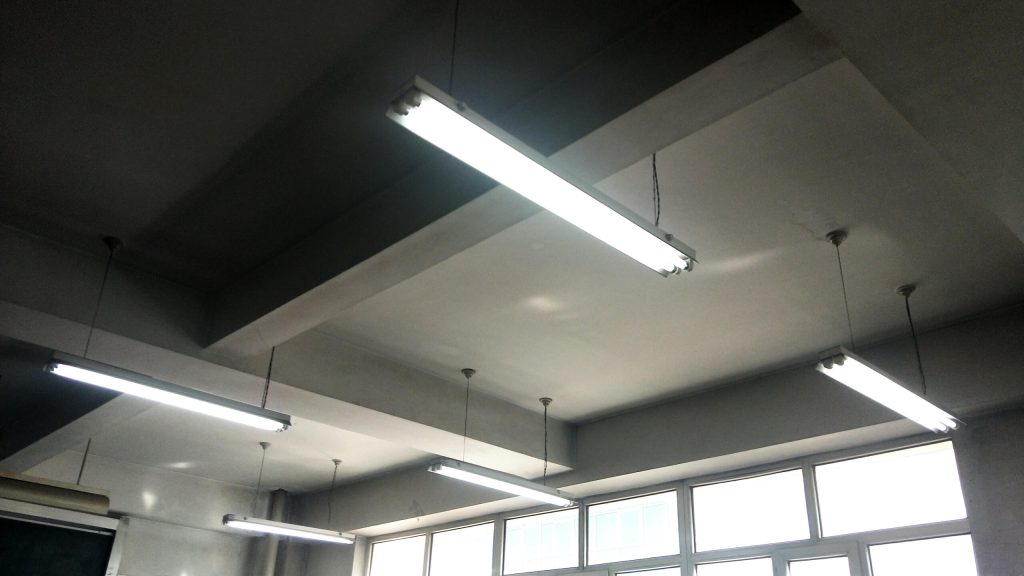
Since 1938, fluorescent lamps have been produced and sold to the public. These lights work by ionizing mercury vapor in a tube that emits photons that produce visible light. A large majority of facilities still use these dated lamps which creates several disadvantages for their businesses. As newer and more efficient lighting options have emerged, we have found many reasons to avoid using these lamps. Continue reading below to learn about these reasons and how fluorescent lighting could be negatively impacting your business.

Inefficiency

Tired of receiving expensive utility bills in the mail every month? What if I told you that you could reduce your lighting cost by 70% which will drastically reduce your utility bill. That’s right, modern LED lights use up to 70% less energy than fluorescent lamps. Fluorescents use a significantly higher amount of energy (Watts) to produce light making them extremely inefficient. By replacing these lights with LEDs, you will effectively reduce your energy consumption which in turn will lower your monthly utility bill.

High Maintenance Cost

Fluorescent lamps last around 10,000 hours on average. An office space that has lights on 10 hours per day, 5 days per week would have annual run hours of 2,600. This means that roughly every 3.8 years, the office would have to replace their lamps. Replacing lamps is costly and takes time away from your facilities team that could be focusing on more important tasks. On the flip side, LED lamps last around 50,000 hours on average. If they were installed in the same office, they would only have to be replaced about every 19 years. Therefore, during the lifespan of one LED tube the office space would be purchasing and replacing their lights 5 times! As you can see, the cost of maintaining fluorescent lighting quickly adds up and can put a burden on any business.

Poor Lighting Quality

Fluorescent tubes fitted in troffers are the most common application for these lights. Since these tubes degrade so rapidly and most troffers fit 2-4 tubes, they can look quite ugly and make a space look dim. To the right, you can see an example of a troffer fitted with fluorescent tubes that are degrading. The tubes vary in light output because they have been replaced at separate times giving the light fixture a dirty and cheap look.

Fluorescent lighting

LED flat panels are a much smoother source of light while being significantly more efficient as discussed earlier. Quality optics and lenses create a clean and even presentation that makes any space look clean and modern. To the right, you can see an example of a RAB flat panel that we commonly install for our customers.

LED panel

Lack of Customization

Over the past few years, we have seen an explosion in lighting technology specifically in controls. Fluorescent lighting has been left behind amidst this growth while LED technology has seen many advances in customization and control capability. Control-enabled LEDs offer many features including daylight harvesting, occupancy sensing, task tuning and more. Learn more about these LED control systems and the features they offer in our blog here.

Health Concerns

As stated in our introduction, fluorescent tubes utilize hazardous mercury vapor to produce light. Since they contain this hazardous gas, a broken fluorescent tube can create serious health hazards to those who are in the vicinity of one. Glass is used as the tube portion of these lights which are prone to shattering as well. Furthermore, fluorescent tubes emit ultraviolet (UV) radiation which has been shown to be harmful to humans.

Employee health and safety is a top priority for any business. We highly recommend replacing your fluorescent tubes to create a better environment for your employees. One broken tube near an employee could result in serious risks for any company.

Overall, fluorescent lights are over 80 years old and haven’t seen much advancement in recent years. If you still utilize these lights, we highly recommend making the switch and taking advantage of the modern, safe and efficient LED lights we have available today. This may sound like a daunting task, especially if you have a large facility which we understand. That is why Integra Energy offers turnkey LED lighting upgrades including everything from securing incentives to product installation.